
Architecture tours in Espoo
Did you know that Espoo is home to some significant architectural pearls from major Finnish architects, such as Alvar Aalto and the Pietiläs? There’s a self-guided tour in Otaniemi and Tapiola that helps you explore the functionalist style of the 1950s and 1960s as well as Alvar Aalto’s characteristic style. Otaniemi has some more modern architecture as well, and you can find more of it in neighbouring Keilaniemi and, as a bonus, next to Nuuksio National Park.
Otaniemi area
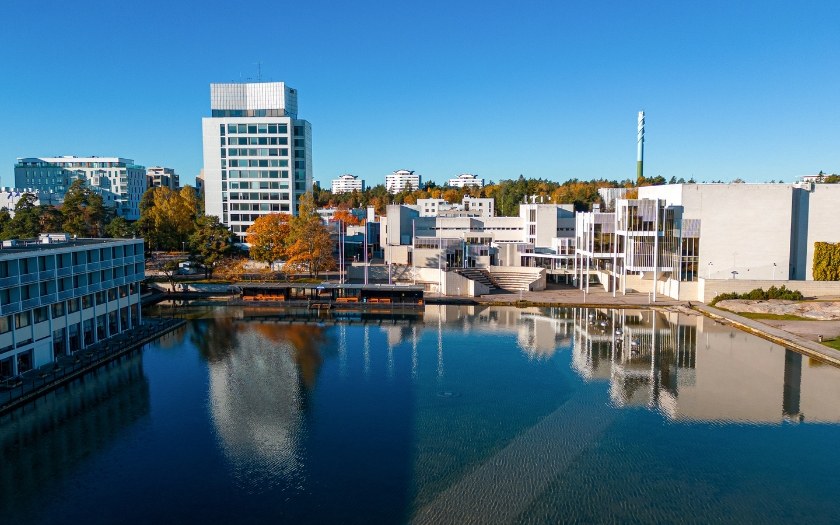
Alvar Aalto’s probably most famous building in Otaniemi is the Undergraduate Centre which was finalised in 1964. It was previously known as the main building of Helsinki University of Technology or “poli” and is still one of the landmarks of the Otaniemi campus. The building forms a scenic whole, and its terraced festival square is lined by an identifiable auditorium reminiscent of a Greek theatre.
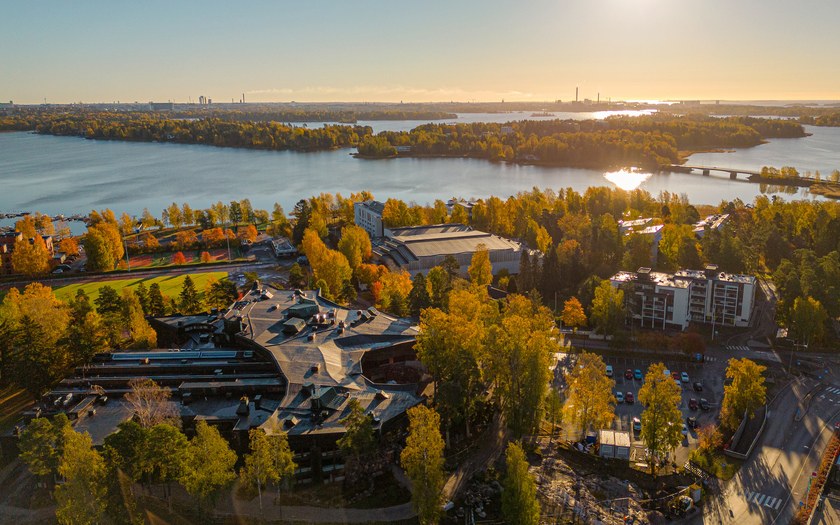
The main building of today’s Aalto University is Dipoli, originally designed in 1966 by Raili and Reima Pietilä as the new university building for technology students. Dipoli, one of the Pietiläs’ main works, is built from natural rocks, concrete, copper and wood. With its unique nature, it is one of the most expressive and radical buildings of Finnish architecture. Depending on the source, only four of the building’s windows are said to be identical. The building is now also a popular congress centre.
Another place worth visiting is Heikki and Kaija Sirén’s Otaniemi Chapel, which represents natural Nordic modernism. It was finished in 1956 and 1957. The chapel’s altarpiece, i.e., the south-facing glass wall, changes according to the season and time of day. The altar crucifix can be found outside, surrounded by nature. Otaniemi has numerous significant architectural works, which you can read more about on the Aalto University website. On the other hand, Otaniemi also has some modern buildings, such as Väre.
Tapiola area
Tapiola is known for the functionalist style of the 1950s and 1960s as well as the term Garden City. The area was built partly as the result of an architecture competition, and thanks to open-minded construction, Tapiola was considered unique in terms of its architecture already in the 1960s. Functionalist examples in Tapiola include Aarne Ervi’s Kino Tapiola and the Tapiola Garden hotel, Tapiola church, Central Tower, Tapiola Swimming Hall, the Hakalehto Atrium houses and the Hip Flask houses.
Another must see location in Tapiola is Exhibition Centre WeeGee, designed by Aarno Ruusuvuori, which is the former printing house of the Weilin+Göös publishing house. Today, the building houses EMMA – Espoo Museum of Modern Art and KAMU – Espoo City Museum. WeeGee’s garden is also home to the Futuro house, designed by Matti Suuronen.
Other architecture in Espoo
Business district Keilaniemi aims high not only in achievements, but also in terms of the height of buildings on a Finnish scale. The most famous building in the area and Espoo’s most known “skyscraper” is probably the Accountor Tower, built in 1976, which is home to Fortum’s headquarters and also known as the Neste Tower or, more literally, “Raade’s tooth”. Today, you can enjoy amazing views and delicious food at the Lucy in the Sky restaurant on the top floor.
Bonus tip
One unique example of modern architecture is Finnish Nature Centre Haltia, which opened its doors in 2013. Haltia is an ecological public wooden building that gets its inspiration from the Finnish national epic Kalevala. As a building, it is designed to adapt to nature. The shape of the building is inspired by the pochard bird. In Kalevala, the world is thought to have been born out of a pochard egg.

Get to know the area with a guide
You can also get to know the Otaniemi campus virtually.
You can enquire about guided architecture tours at Aalto University, which organises campus tours.
As well as from guide and storyteller Tuula Pohjalainen.
Hero Image: Joni Viitanen